
Marathon Training Pain: Calf, Knee, Thigh & Ankle Care
An assessment-led approach to managing symptoms, rebuilding strength, and making informed training decisions.

Your long run is getting longer, race day is getting closer, and the same calf tightness or knee ache keeps returning. Should you stretch more, strengthen more, or change your training?
The starting point is understanding what hurts, when it hurts, and what your body can currently tolerate. Calf pain, knee pain, thigh pain, and ankle pain during marathon training can have different explanations—even when they feel similar.
At LYS Acupuncture in the Flatiron District of New York City, we begin by assessing range of motion (ROM), strength, pain, and movement. We use those findings to guide symptom management and appropriate exercise, then reassess the activities that matter to you.
Why we assess before treating running pain
A runner who hurts during the first mile may need a different plan from someone whose symptoms begin late in a long run. We consider recent changes in mileage, pace, hills, recovery, and the timing of symptoms. Training-load guidance supports looking at the demands on an athlete alongside recovery and well-being, rather than treating mileage as the only variable.[7]
Depending on your symptoms, an assessment may include ankle and knee mobility, calf and thigh strength, hip strength, walking, a squat or step-down, and running when appropriate. These tests help guide care; a single test does not reveal every cause of pain.
Calf, knee, thigh, and ankle pain: what we look for
Calf pain during marathon training
When the calf feels persistently tight, we look beyond the sensation of tightness: where is the pain, did it begin suddenly, and does it change with walking, running, or a heel raise? We assess the calf muscles, ankle movement, and nearby Achilles region as appropriate. A muscle strain and Achilles tendon pain call for different decisions; not every painful calf needs deeper stretching.[9]
Knee pain when running
For pain around or behind the kneecap, we consider the knee itself as well as hip function and the demands of your training. For diagnosed patellofemoral pain, current best-practice guidance places education and knee-targeted exercise, with hip-targeted exercise when appropriate, at the center of care.[1]
We do not assume that a weak gluteal muscle caused every runner’s knee pain. Hip weakness can accompany patellofemoral pain, but that association alone does not establish which came first.[8]
Thigh pain: quadriceps and hamstrings
Front-of-thigh and back-of-thigh symptoms deserve their own assessment. We ask about the exact location, the workout that preceded the pain, and whether symptoms affect daily movement. Sudden pain during a faster session should not automatically be labeled a trigger point or ordinary post-workout soreness. The examination helps determine whether muscle-related care is appropriate or further evaluation is needed.[9]
Ankle and Achilles pain
Ankle pain can involve different structures, so the location and examination matter. When the diagnosis is midportion Achilles tendinopathy, the 2024 clinical practice guideline recommends progressive tendon-loading exercise as first-line treatment. That recommendation applies to a defined tendon condition; it is not an exercise prescription for every painful ankle.[2]
Can pain and trigger points change how muscles work?
Pain can change how activity is distributed within and between muscles. This may help protect a sensitive area, but persistent changes can also affect movement and loading. It does not mean that your body is permanently out of balance.[3]
Research on latent myofascial trigger points has also found differences in muscle activation timing during shoulder movement. This suggests a possible relationship with muscle coordination, but it does not prove that trigger points cause a marathon runner’s leg pain—or that they must be eliminated before exercise can work.[4]
Our practical response is to assess both symptoms and function. We look at whether treatment changes your comfortable movement or ability to perform an exercise, rather than assuming that tenderness alone explains the problem.
Where dry needling fits in marathon recovery
At LYS Acupuncture, dry needling and trigger point–focused treatment may be used when appropriate to help manage symptoms. We then reassess pain, ROM, and movement, and connect any improvement to an exercise plan.
Evidence continues to evolve. A 2024 patellofemoral pain guide did not find a clear additional benefit from adding dry needling to hip-and-knee exercise. A 2025 review reported benefits, while a 2026 review of knee disorders reported short-term improvements but highlighted variation between studies and limitations in blinding and follow-up.[1][5][6]
Dry needling may be an adjunct for selected patients. It does not replace progressive exercise, establish that a tissue has healed, or clear a runner for race day.
From symptom relief to running capacity
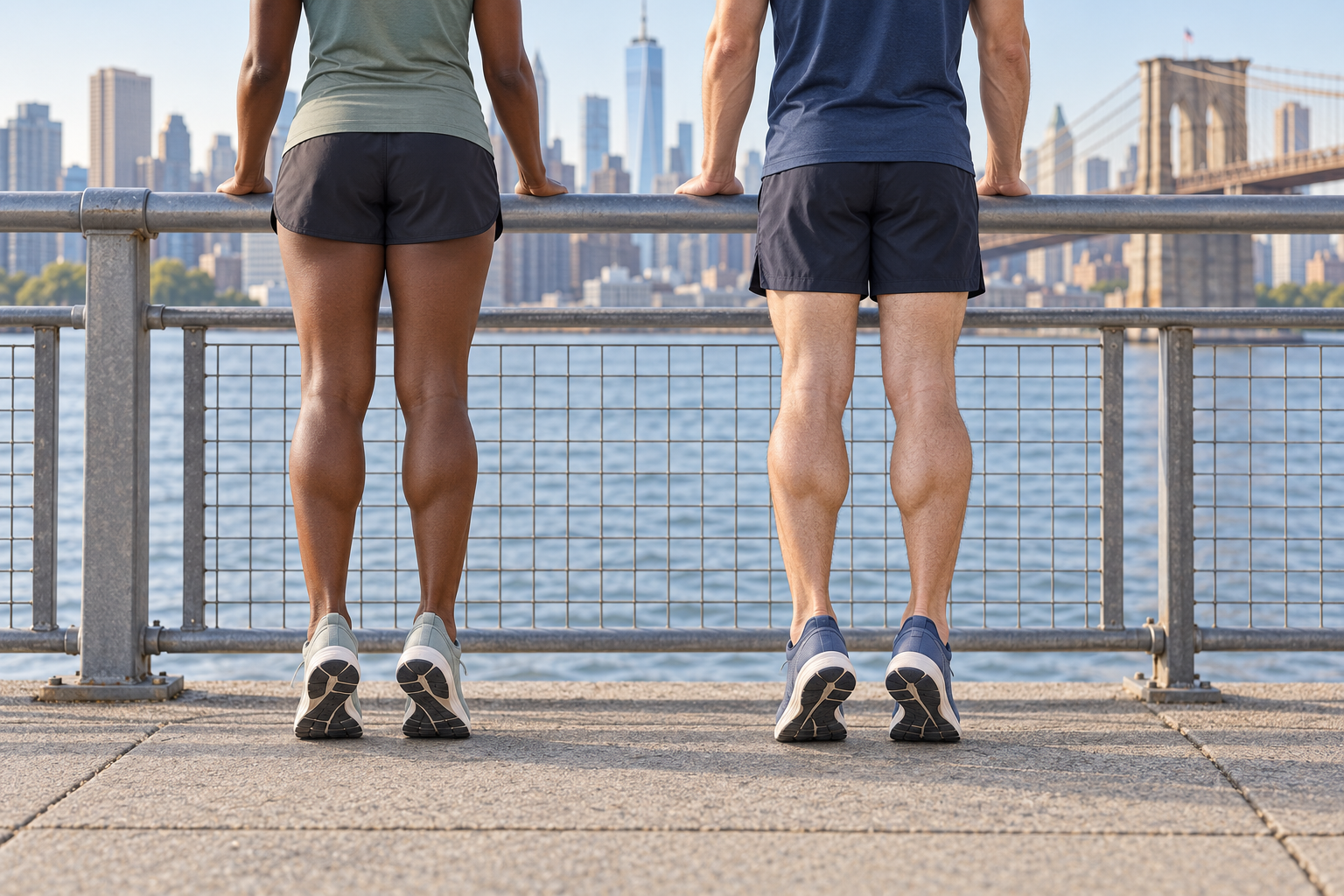
After assessment, exercise may include calf loading, quadriceps strengthening, hip strengthening, or movement practice. The choice, range, and resistance depend on your diagnosis and response. There is no single corrective routine for all marathon runners.
We reassess what has changed and what still needs work. A less painful squat or easier heel raise can be useful progress, but a brief improvement is only one part of deciding how to rebuild training.
What to do when pain interrupts your training plan
- Record the pattern. Note when symptoms start, what session brings them on, and how you feel later and the next morning.
- Review recent demands. Include faster workouts, hills, long-run duration, and recovery—not just weekly distance.
- Get recurring pain assessed. Especially when it worsens, changes your stride, or affects walking, avoid repeatedly testing it with another hard run.
- Individualize the return. Training changes and exercise progression should follow the diagnosis and your response, not the pressure of the calendar.
These are monitoring principles, not a universal return-to-running protocol.[7][9]
When running pain needs medical attention
Seek medical assessment for persistent focal pain that worsens with impact; a bone stress injury needs a different plan from muscle soreness. New one-sided calf swelling with pain needs urgent medical assessment. If accompanied by chest pain or breathlessness, seek emergency care.[10][11]
Frequently asked questions
Should I stretch a tight calf before every run?
Recurring calf pain deserves assessment before simply adding more stretching. The right approach depends on what is producing the symptoms.
Do trigger points have to be treated before strengthening?
No mandatory sequence has been established. Symptom treatment and suitably adjusted exercise can be used together; complete pain relief is not a universal prerequisite for starting exercise.
Can I run my marathon if treatment reduces the pain?
Pain relief alone cannot determine race readiness. That decision needs to consider the diagnosis, function, and tolerance of progressively demanding training.
Educational information only; this article does not diagnose an injury or provide an individualized training prescription. Treatment suitability and outcomes vary.
Sources & further reading
- Neal et al. (2024). Best practice guide for patellofemoral pain. British Journal of Sports Medicine.
- Chimenti et al. (2024). Achilles Pain, Stiffness, and Muscle Power Deficits: Midportion Achilles Tendinopathy Revision. JOSPT.
- Hodges (2011). Pain and motor control: From the laboratory to rehabilitation. Journal of Electromyography and Kinesiology.
- Lucas et al. (2010). Muscle activation patterns in the scapular positioning muscles: effects of latent myofascial trigger points. Clinical Biomechanics.
- Rashnavadi et al. (2025). The effectiveness of dry needling in patellofemoral pain syndrome patients: A systematic review and meta-analysis. Journal of Bodywork and Movement Therapies.
- Hu et al. (2026). The effectiveness of dry needling at myofascial trigger points for knee disorders. PLOS One.
- Soligard et al. (2016). IOC consensus statement on load in sport and risk of injury. British Journal of Sports Medicine.
- Rathleff et al. (2014). Is hip strength a risk factor for patellofemoral pain? British Journal of Sports Medicine.
- NHS. Knee pain and other running injuries.
- Gloucestershire Hospitals NHS. Caring for a stress fracture.
- NHS. Deep vein thrombosis (DVT).